
Real Estate with Heather Tankersley, REALTOR® with Keller Williams

The Price You Set Can Make (or Break) Your Sale

There’s one decision you're going to make when you sell that determines whether your house sells quickly, or it sits. Whether buyers make an offer or scroll past it. Whether you walk away with the maximum return, or you end up cutting the price later.
And that’s your asking price.
The #1 Mistake Sellers Make Today: Trusting the Wrong Number
If you’re thinking of moving and trying to figure out what your house may sell for, it’s tempting to start with an online home value tool. They’re fast, free, and easy. And you don’t have to talk to anyone. But here’s the problem: they don’t know your house.
And that can be a bigger drawback than you realize.
Where Online Estimates Fall Short
Online tools often lag behind the market. They look in the rearview mirror, relying on closed sales and delayed information. And in that sense, they’re using incomplete data.
That’s not a miss in how these systems are built. Some information just isn’t available online. Bankrate explains:
“While these tools can be a useful starting point, keep in mind that they typically do not provide the most accurate pricing. Algorithms can only rely on the information available; they can’t account for things like a home’s condition or renovations made since the last public information was updated.”
They can’t see:
● The unique features that make your house special
● All the work you’ve put in to keep it in good condition
● Or, how in-demand your specific neighborhood is right now
So, while they may do a good job in some cases, they can’t be as accurate as a local agent who has boots on the ground day in and day out.
In a market where buyers have more options, a seemingly small margin of error can cost you thousands if you price too low, or weeks of lost momentum and time if you price too high.
If you want to sell for the most money and in the least amount of time, you don’t want the fast answer on how to price your house. You want the right one.
That’s why the savviest homeowners today don’t rely on algorithms when it actually matters. They rely on people, specifically trusted local agents.
What an Expert Agent Brings to the Table
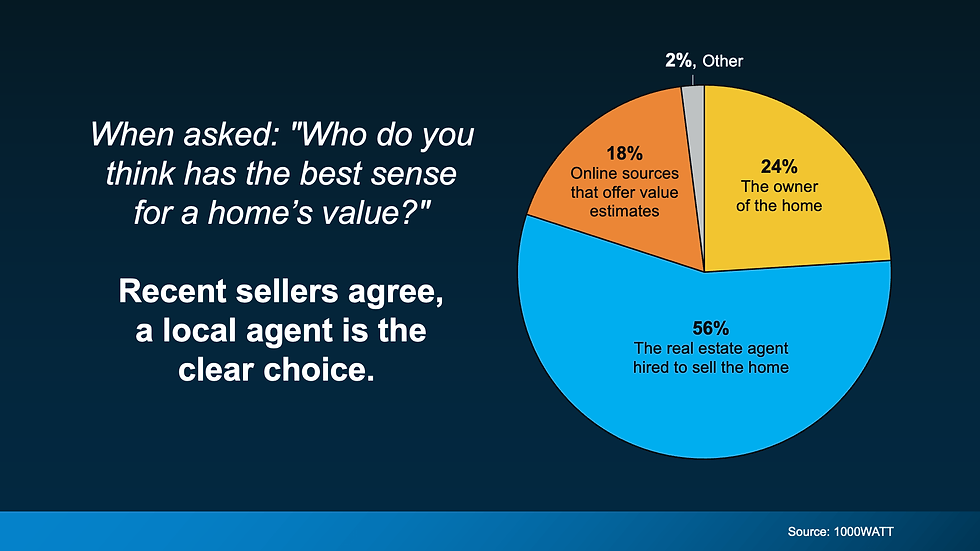
According to 1000WATT, sellers overwhelmingly believe real estate agents have the best sense of a home’s true value, far more than any automated tools.
That confidence isn’t accidental. As Bankrate puts it:
“A professional appraiser or real estate agent can visit the home in person, assess the neighborhood as a whole as well as the individual property, perform more thorough market research, and consider subjective details.”
And those details matter. A skilled local agent doesn’t just pull reports. They know what’s happening right now:
What buyers are paying this month, not last month, or even last year
How your home compares to the current competition in your neighborhood
Which features add value based on what buyers are willing to pay for today
How to price your house to create urgency in this market
And once an agent steps foot in your house, they may even find your online estimate undershot your value. So, if you stuck with the estimate you got online, you’d actually be leaving money on the table. And no one wants that.
Bottom Line
While online tools can give you a rough starting point, only a local expert can give you a price that actually works.
If you want to know the right number for your house, not just the easiest one to find, let’s talk.
Move-Up Buyers Are Choosing New Construction
At some point, a house that once felt perfect just… doesn’t anymore.
Maybe you need more space.
Maybe working from home turned your dining room into a permanent office.
Maybe the layout just doesn’t match how you live now.

If your current house is starting to feel like it’s holding you back instead of supporting your life, it’s natural to think about making a move. But that brings up the next big question: once you sell, where do you go?
For a growing number of buyers, the answer is something brand new.
New Construction Is a More Popular Choice Lately
According to the National Association of Realtors (NAR), more people are buying new homes than they have in years. The latest annual data available shows 16% of homes purchased were newly built.
At first glance you may not see why that’s a big deal. But that’s actually the highest share of new home purchases in almost two decades.
Why More Buyers Are Choosing a Brand-New Construction
For many buyers, especially move-up buyers, new construction isn’t just about aesthetics. It’s about lifestyle, convenience, and peace of mind.
1. Everything Is Brand New
You’re not inheriting someone else’s projects. No wondering how old the roof is. No budgeting for a new HVAC right after move-in. No big surprises when the previous owners patch job fails. For move-up buyers who’ve been dumping money into updating their current house, that’s a win.
2. You Can Customize Before Move In
If you choose a home that's still under construction, you could have the chance to pick the flooring, counters, cabinets, hardware, lighting, and so much more. That level of personalization can be a draw for move-up buyers like you, because it allows you to hand pick the fit and finishes you've been wanting for so long.
3. A Home Designed for How People Live Today
Most new construction homes are built to current building standards and buyer preferences, which means you could see built-in smart home features, better energy efficiency (which can lower utility bills), and even more modern floor plans and features. And if your layout just isn’t working for you anymore, you may find exactly what you need now in a new home.
4. Neighborhood Amenities
New developments often include shared community spaces like walking trails, parks, playgrounds, or even pools and gyms. For families and active households, that’s a big bonus to have that just a few steps out of their front door.
5. Builder Incentives
Not to mention, since there are more new homes on the market than the norm, builders are motivated to sell what they have. So, you may find they’re more willing to negotiate than you’d expect on things like price, upgrades, and more.
Bottom Line
If your current house isn’t meeting your needs anymore, don’t assume your only choice is an existing home. New construction is becoming a real contender, especially for move-up buyers who want space, features, and a home that works for how they live now.
Curious whether new construction might be a fit for you? Let’s chat.
Four Ways Your Home Equity Can Work for You
You may have heard homeowners today have a lot of equity built up. But what does that really mean? Let’s break it down.

Because your equity isn’t just a number, it’s a powerful asset that can help you take your next big step in life.
How Much Equity Does the Typical Homeowner Have?
Here’s how it works. As you pay down your loan and home prices rise through the years, the share of your home that you own free and clear grows. That’s your equity.
And according to data from the Census and ATTOM, two-thirds of homeowners have a substantial amount of it today.
39% own their home outright without owing anything on it. And another 27% have at least 50% equity in their homes (see chart below):

That’s a big deal. And just in case you’re wondering how that translates into real dollars, Cotality says the typical homeowner has almost $300k in equity today. That’s six figures.
And whether you have that much, even more, or a bit less, here are a few examples of how you can use it.
Ways You Could Use Your Home Equity
1. Move Into a Home That Better Fits Your Life
Your needs change over time. Maybe your home is starting to feel cramped, or maybe you have more space than you need now that your adult children have moved out. Either way, you can use your equity as a down payment on a home that’s a better fit for what you need now, and going forward. You may even have enough equity to buy your next house in cash.
2. Upgrade Your Current Home
And if you’re not ready to move just yet, you could reinvest it in your current home instead. Renovations like a kitchen refresh or updated bathrooms could add value when it’s time to sell down the line. Just be sure to talk to a real estate agent before you tackle your project list, so you can prioritize updates that’ll give you the biggest return later on.
3. Fund a Major Life Goal
Equity can also help fund your life goals – whether it’s starting a business, saving for retirement, covering education costs, or helping out someone you love. Some homeowners are even passing down some of that wealth to help fund a loved one's down payment on a home.
4. Avoid Foreclosure in Tough Times
If you’re struggling with payments, your equity can also be a lifeline. Many homeowners who hit financial hardships can sell their homes and walk away with money in their pockets instead of facing foreclosure. If that’s something on your mind, talk to a real estate expert about your options and how your equity can help.
Your Next Steps
If you’re interested in using your equity for one of the reasons above, here’s what to do:
● Step 1: Ask a local agent for a personalized equity assessment on your home.
● Step 2: Meet with a financial advisor if you’re interested in using that equity.
Because when it comes to tapping into this resource, there are a few things you’ll want to keep in mind – like making sure you still have a good loan-to-value ratio (LTV) even if you use some of your equity.
That means, as a general rule of thumb, you want to maintain at least 20% equity in your home as a financial cushion – something many homeowners didn’t know back in the crash of 2008.
The good news is, according to the Intercontinental Exchange, most of today’s equity meets that guideline:
“As of Q4, mortgage holders have $17.3T in home equity, including $11.2T in tappable equity ‒ accessible via cash-out refinances or home equity lines while maintaining 20% equity in the property . . . ”
Bottom Line
Your home equity is one of the biggest financial assets you have. Whether you’re thinking about moving, remodeling, or working toward a big goal, it’s worth exploring your options. Reach out to a financial advisor to learn more.
What’s one goal you have that you'd go after right now, if you had the funds for it?
Inventory Is Making a Comeback in 2026
After a long stretch where buyers were competing for too few homes, inventory has made a comeback over the past year. And depending on where you live, that’s opening up your options in a meaningful way.

According to Realtor.com, the number of homes available for sale in January was the highest it’s been since 2020. Here’s why that’s such a big deal. Getting back to pre-pandemic levels signals a slow and steady
return to what’s typical:

Now, it’s worth noting, nationally we’re not there yet – and having more inventory improving won’t suddenly “fix” the market. But the growth we’ve seen lately still changes how competitive the market feels.
When there are more homes for sale, buyers gain time, options, and leverage.
When there aren’t, the pressure ramps up quickly.
In the years since 2020, there weren’t enough homes for sale, and that made the market feel different. Rushed. Stressful. Intimidating.
But now it’s finally getting better.
A Growing Portion of the Country Is Getting Back to Normal
Depending on where you live, inventory growth is going to vary. Some places are bouncing back faster than others. According to Lance Lambert, Co-Founder of ResiClub, in January 2025, just a little over one year ago, only 41 of the 200 largest metros were back to normal inventory-wise.
But around the end of year, almost half (90) of the largest 200 metro areas were back at or above typical levels. That’s a big improvement in roughly a year. And it’s not done yet.
Inventory Is Expected To Keep Growing
Looking ahead, forecasts suggest the number of homes for sale could rise another 10% this year, which means even more markets should join the list of places where supply has rebounded.
Here’s a graph that shows what an extra 10% would do for the market this year. You can see that projected growth (shown in the dotted line) hits inventory levels seen in 2017-2019 by roughly this fall (the gray lines). That means we may reach normal by end of year, nationally:

And that changes your home search in a good way. As Hannah Jones, Senior Economic Research Analyst at Realtor.com, puts it:
“. . . housing market conditions are gradually rebalancing after several years of extreme seller advantage. Buyers are beginning to see more options and modest negotiating power as inventory improves . . .”
In other words, the market is starting to work with buyers again — not against them.
Bottom Line
Inventory isn’t fully back to normal everywhere. But it’s moving in the right direction. And, in some areas, it’s already there.
If you’ve been waiting for a moment when you have options and a little breathing room, this is the strongest setup buyers have seen in a long time.
If you want to know what’s happening in our local market, let’s talk.
It’s Your Move! I believe every homeowner should feel confident when selling and buying a home. Heather Tankersley REALTOR®,
ABR® Keller Williams Tri-Lakes D: 417.332.5130 O:417.336.4999


Comments