
Branson’s $30 million emperor wears no clothes

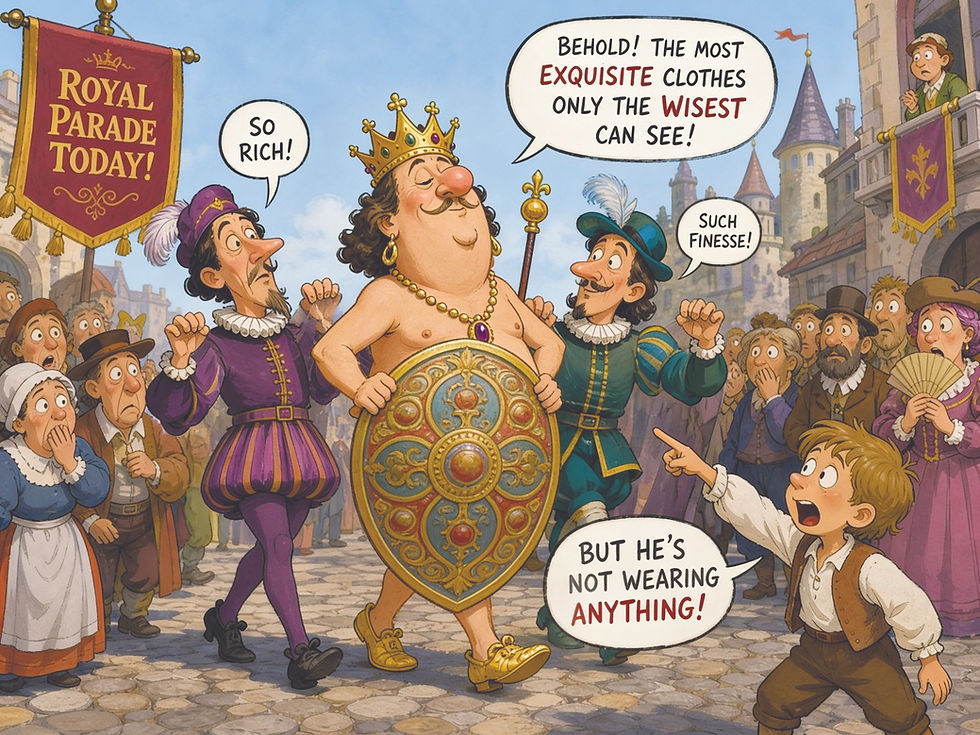
The $30 million verdict awarded to a local developer by a Taney County court and jury reminds the Ole Seagull of a fairytale about the emperor’s new clothes. You remember the story. Two conniving tailors convince an emperor they’ve woven him the finest suit in the land — a fabric so fine that only the wise can see it. Fools and the unfit for office, they warn him, will see nothing at all. The emperor, terrified of being thought of as a fool, marches through town buck naked, and everyone watching claps and admires the invisible cloths rather than admit they see nothing but the emperor naked.
It takes one child, unburdened by the fear of looking foolish, to shout what everybody already knew: “He hasn’t got anything on!” In an Ole Seagull's opinion, the Taney County court and jury just wove the developer a $30 million suit of the same invisible material.
Instead of a naked emperor, we have a private developer parading around town with a $30 million verdict against the City of Branson. A Taney County court and jury were the tailors of the $30 million suit, which the developer, the Ole Seagull, believes, for good reason, has been at “city hall” trying to settle since before the appeal process even started.
The basis of the case is a developer’s contention that the city promised to build them a massive commercial water system. The judge, just prior to closing arguments, told the jury that the city had "a duty to plaintiff under the annexation agreement to provide a supply of water suitable for fire protection and commercial development to plaintiff’s property.” Signed 25 years ago, the agreement is clear. It states that the developer is responsible for designing and building the water lines, facilities and the water volume needed on the property.
The city only agreed to pay to build and maintain the Fall Creek Interceptor Sewer Line. They agreed to bring it right to the edge of the owner’s property. That is exactly where the city’s duty ended. But the developer’s lawyers spun a story out of thin air by pointing to an introductory clause at the very beginning of the document. That clause said the owner wanted to get a water supply suitable for commercial development. It was an introductory desire and created no duty on either the developer or the city.
Another paragraph points out that the written document is the complete agreement. It states there are no other promises or understandings outside of what is written down. You cannot get much plainer than that. Yet, the developer, just like the tailors of the emperor’s new clothes, convinced the jury to award them 30 million taxpayer dollars.
In the fairytale, it took a little boy in the crowd to finally point his finger and shout the truth. Hopefully the appeals court will step up and do the exact same thing. They will look at the plain, written truth of the 2001 agreement, point out that the verdict is legally “naked,” and reverse it.


Comments